Public initiatives and state policies amidst limited funding often raise a fair share of eyebrows at decisions made and the eventual (part-)implementation. Not to go as far as to say there's a missing or dubious agenda to this festival but the way things came about does come with more than a single question. The mismatch between various aspects of the whole endeavour only goes to underline the impossibility of something like this happening within a fully commercial setting.

Dzeltenie Pastnieki at Mežaparks Grand Bandstand on Friday, 13.06.2025
So let me lay out the land for you. It starts with the venue, the Mežaparks Great Bandstand in the deep greenery behind the zoo in the north of Riga, a huge open-air song festival ground with an estimated capacity of 60 000. Then there's the public cultural institution operating the venue and the idea hatched at the tail end of a year to stage a festival with the focus on alternative music in about six months' time. Given the post-pandemic entertainment industry's fierce competition for audiences, venues, and time-slots, with tours planned up to two years in advance, who'd be crazy enough to even consider it?
Frankly, I had no idea what to expect. On the one hand, it seems like something huge is brewing. On the other, what is this idea of "alternative" anyway? It's hard to pin the focus going by the name alone. Are we talking alt. rock and/or metal? Or are we talking alternative as in non-mainstream and alternative to pop? Is it a music festival or does it go far and beyond? What's in the cards and how far does the definition of it stretch anyway? Most importantly, who's the target audience? And finally, who on earth stages a two-day festival spanning Thursday and Friday??
All those questions were running through my mind as I entered the grounds with 5 minutes to spare to find this minuscule stage in front of the huge choir area facing the field occupied by maybe ten people in grey weather that was promising wet misery... That and not much hope for something called DJ Krankenwagen. But if weather did indeed turn out to be on the wet side on Thursday, the event and the music were far from being the bleak image of the first moments on site.
DJ Krankenwagen happened to be an entertaining full-fledged band supported by a choir, and ranging from industrial beats to experimental music and what have you. Or, in other words, a kind of the embodiment of the nature of the festival and a suitable opener. Also, a distinctly Latvian thing on this festival—something I was going to experience on several occasions—tapping into these devoted followers who always make you feel like you've been missing out on the best underground act of the past decade.
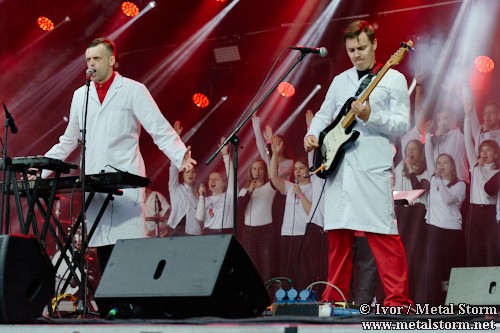
Linards Kalniņš, Mārtiņš Ennītis and Dziesmuvara Choir (DJ Krankenwagen)
It's hard to put a finger on what this festival represented, though. Moving from the rocking performance of Dzelzs Vilks on to a fusion of Latvian folk and African rhythms on the balafon—think xylophone made of gourds—courtesy of Nielslens Lielsliens—yes, a nod to late Mr. Nielsen there and at times as silly as the man himself—the divide between the genres seems, well, divisive. In practice and going by the warm audience reception it was anything but, with the energetic and provocative Maruja and Faroese folk art pop of Eivør on the main Park stage, the tranquil stoner of Mars Red Sky and pounding sludge of Kannabinõid on Forest stage, and performative dance by the Lauga collective and a blend of guitar and poetry reading by Edgars Rubenis and poet Marija Luīze Meļķe in the Theatre tent. There was an atmosphere of unity and of hippie-like vibes; and nose rings, and black paint, and spikes; an atmosphere of anything goes. The closest resemblance was that of a folk festival covering acts from traditional fiddle jig to folk metal and anything in between. Except, alternative? And that seems to be the thing. Just like the most personal is the most political, the most alternative in this context appeared to be deeply rooted in the traditional.
The genre-hopping of the second day was in a way even more extreme. Not to go through the whole lineup, but to go from the folk of JUUK to the post-black metal of Harakiri For The Sky to the one-man acoustic performance of :Of The Wand And The Moon: to the doom metal of The 3rd And The Mortal only to conclude with the ritualistic, shamanic beats of Vėlių Namai is kind of like trying to be everywhere all at once. I kind of see the intent to expand horizons at work here, and the aim to present this festival as a cultural phenomenon encompassing other forms of creative expression besides music, but at face value it was still primarily a music festival and of the rest there was too little. Perhaps it's a teething issue of the first edition of the festival because, there is a shimmer of the conceptual idea and a binding thread running through it all, just not very obvious. The main question is that of the balance and the emphasis. And of course the target audience.
Despite many international acts being on the bill, it quickly became apparent that the festival was first and foremost targeting the local music scene. It's one thing when bands sing in their native language but quite another when communication and banter with the audience proceeds the same way. Many times I found myself watching the event pass by on the sidelines. The rare exception that I could understand was when JUUK's guitarist off-handedly threw a joke at the singer picking up a banjo asking if people knew of the band called Banjo Vi—come on, say it out loud, writing doesn't do it justice.
But even two weeks after the festival I keep returning to the question of who this event is for. There's not much alternative about the fusion of influences and a lineup spanning a wide range of genres. If it's all-around it's going to be hard to gather a consistent audience and keep it interested throughout the whole festival. Looking around me I could see maybe 600 to 800 people, which was a comfortable amount for the Forest Stage, but this audience was completely dwarfed at the Park Stage, and was likely also a discouraging view for the artists. But perhaps masses were never the intent. I can't help but think of it as a niche, subcultural, local scene event that just happened to have this huge venue on hand. That being said, from the perspective of the audience it meant that everybody could pick their favourite spot to enjoy the shows.
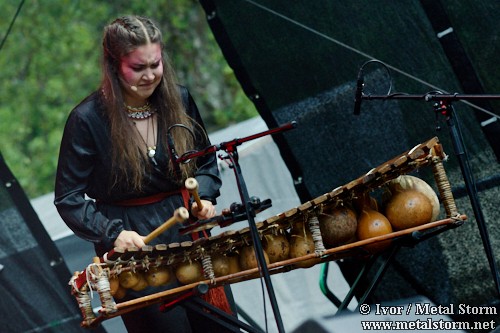
Vija Moore (Nielslens Lielsliens)
And, to their credit, the festival mostly delivered on enjoyable. As always, not everything was for everybody but that is rarely the point. The better question is whether the festival managed to achieve its goal in offering attendees some new experiences. I can't really speak for others but I found myself enjoying some of the acts that I wouldn't have considered to top my list. Maruja would've definitely made the cut but I had already seen them half a year ago and they were there more or less with the same show. Nielslens Lielsliens were a genuinely fun thing live, though, definitely the most surprising of the bands. Nova Koma came across full of energy and, somehow, very relatable despite their Latvian lyrics, which may once again underline that a live performance can forge connections with the audience on different levels and in many ways. DZ were great because it's perhaps more my kind of thing. And, the initial wtf emotion aside, DJ Krankenwagen deserve a shout-out for all the effort they put into their show and the music.
Eivør as the first headliner of the festival were nothing short of spectacular. The beautiful colours, both visual and musical, were more than fitting the atmosphere on the grounds. Or perhaps it was the other way around and the weather was a fitting host to the Faroese artist, making them feel more at home. The performance Eivør delivered can in no small amount be described as otherworldly and mysterious but also kind of cinematic. That blend of pop—particularly emphasised by the electronic-sounding drums—and folk—that characteristic throat-singing technique goes a long way here—within the ambient soundscapes accompanied by the occasional guitar was strikingly harmonious and unique. Strong was the feeling of being transported to an imagined world—imagined by the band and the listener alike.
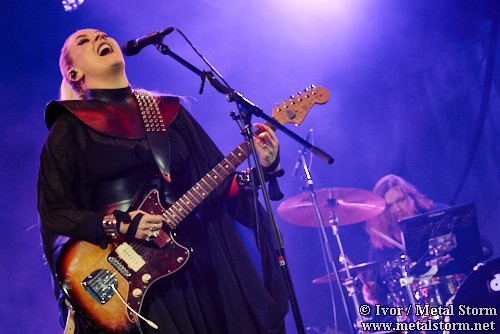
Eivør Pálsdóttir and Per I. Højgaard Petersen (Eivør)
Emotionally, however, The 3rd And The Mortal moved me the most. This was their reunion show of the lineup that recorded the first EP, Sorrow, and the following iconic doom metal début album Tears Laid In Earth, performing that very same material—the first one in about three decades. Thing is, their first show was supposed to happen in August at Midgardsblot festival. It's still happening but Latvians have worked a small miracle and have managed to steal the initiation ceremony. I wonder, though, if the band wanted a smaller test drive prior to appearing before their country-fellows?
The significance of the moment stayed with me the whole time. One might equate this reunion to many others and consider it a play at nostalgia; whether the band's or the audience's is irrelevant. And the case indeed may be so. However, back when the album was released in 1994, I knew nothing about listening to music consciously, let alone such music. I found the album when the band were a totally different entity and on the way out. The band that recorded the album simply didn't exist anymore. So to me, rather than about nostalgia, this show was literally seeing something that I couldn't have ever seen before. Nor really thought possible, to be honest. As such I was keen to be at the very beginning of the continuation of the journey that started and ended without me.
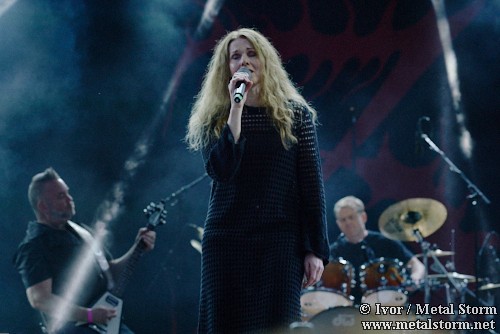
The brooding nature of The 3rd And The Mortal's music isn't one for striking energetic shows, I presume. As the band put it, think of the morning mist. That doesn't mean it was low on intensity. The feeling they evoked with their instruments and voice came across and was mesmerising. Yes, I'm partial to the band and the music, as well as the moment, but it was most definitely deeply touching, at least for me. If anything, though, the band appeared to be slightly stage-shy. And maybe there was also a sense of the mismatch in the air between the music, the stage, the huge grounds, and the scant audience. The latter became even smaller as more than half of the them moved on to the final act on the Forest Stage, Vėlių Namai—a very unfortunate scheduling issue forced upon the organiser by the rules that be. I hope the Mortals weren't discouraged by this in any way. It's got nothing to do with their first performance, just that the people and the organiser should've known better. The show was magical and we even got to hear "Oceana" in full!
All in all, I got what I went to the festival for—namely the magic of The 3rd And The Mortal. And I didn't even have to go to Norway for that. The rest was a bonus entertainment. I think the festival did great, though, all things considered. They didn't get all the acts they approached on short notice but they did make their best effort with great results. I hope that in the future they manage to iron out the issues around planning, the dates, and the scheduling. And, for the love of their audience, I hope they won't try to go ahead with what was their initial idea to stage the main acts at half an hour past midnight. It almost made me decide against going. That's not me getting older here—that's just not very user-friendly, so to say. Otherwise, good job!

Julius Mitė and Dainius Čepulis (Vėlių Namai)
PS! A public service announcement for all of you parents who go to a festival or a concert with your kids. Great initiative! If, however, you love your child as much as I'm sure you do, get them earplugs or proper hearing protection. If you don't know better or don't care about your own hearing, so be it, but you have no right to ruin your child's future quality of life by simply being ignorant. They won't even know what they will miss in this world. Hearing loss comes in many forms and all of them suck bad. I may be able to give one suffering kid the spare foam plugs I may happen to have on me but it's hardly my place to be their saviour when they wince and stick fingers into their ears. Nor am I made of earplugs, as cheap as they may be, so I can't save them all. It's your place to protect them. The best I can do is inform you—the wider you, that is—about it.